


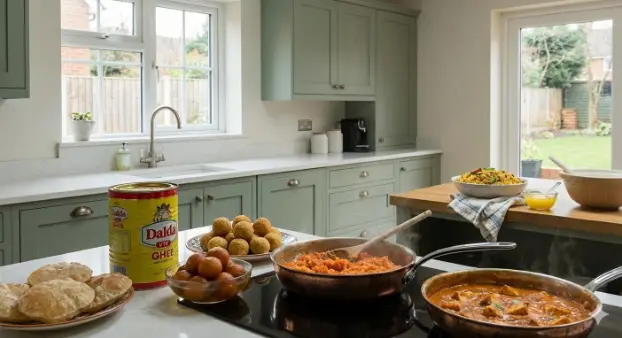
Ah, Dalda. Just saying the word conjures up a particular scent for so many of us in the British-Indian community – that familiar, slightly nutty aroma wafting from a sizzling pan of aloo parathas or the deep-fryer working overtime on Diwali samosas. It’s not merely a cooking fat; it’s a time machine. For countless families across the UK – from Leicester’s golden mile to Southall’s bustling high street, and right up to the quieter corners of Glasgow and Manchester – a tin of Dalda in the cupboard is as much a fixture as a jar of mango pickle or a packet of basmati rice.
Let’s start at the beginning, shall we? Dalda wasn’t born in Britain, of course. It arrived in the 1930s in what was then British India, courtesy of clever Dutch importers and later Hindustan Lever (the forerunner of Unilever). The name itself is a clever mash-up: “Dada” from the original Dutch firm, with an “L” slotted in for Lever. It was marketed as an affordable, vegetarian alternative to traditional desi ghee – that luxurious clarified butter made from cow’s milk, which back then was a proper treat, reserved for festivals or the well-to-do. During colonial times and the lean post-war years, proper ghee was often out of reach for ordinary households. Dalda changed that. It mimicked the texture and frying properties of ghee without the dairy or the price tag, and it quickly became synonymous with “vanaspati ghee” itself. The brand’s iconic yellow tin with the green palm tree became a symbol of accessible abundance.
Where to Buy: Dalda VTF 1KG Pack
Fast-forward to the UK, and the story repeats in a new setting. Waves of South Asian migrants arriving from the 1950s onwards brought their recipes, their memories, and their kitchen staples with them. In those early days – when Indian groceries were few and far between – finding ingredients meant trips to specialist shops or parcels from back home. Dalda tins, sturdy and shelf-stable, travelled well and lasted forever. For many first-generation parents and grandparents, cracking open a fresh tin felt like bringing a piece of home to a rainy council flat in Birmingham or a terraced house in Wembley.
That nostalgia runs deep. Ask anyone in their 40s or 50s who grew up in a British-Asian household, and they’ll likely tell you about Mum or Nani using Dalda for everything: frying bhajis until golden and crisp, creaming it into nan khatai biscuits that melt in the mouth, or layering it into rich, buttery biryanis for Eid or weddings. It wasn’t just functional; it carried emotional weight. The distinctive semi-solid texture at room temperature, the way it held its shape in pastry, the subtle aroma it lent to sweets like gulab jamun or halwa – these were the tastes of family gatherings, of Diwali lights and Christmas Day curry parties where aunties compared notes on whose laddoos were best.
Even today, in 2026, you’ll find Dalda on the shelves of Asian supermarkets across the UK – Hallans, Spices of India, local cash-and-carries, even online via Ubuy or specialist sites. It comes in those classic tins, from 1kg right up to whopping 5kg ones for the serious home cook. And while premium grass-fed cow ghee has surged in popularity (all those A2, organic, Ayurvedic varieties now stocked in Waitrose and Whole Foods), Dalda refuses to fade away.
Why? Practicality plays a big part. Vegetable ghee like Dalda is 100% vegetarian (no dairy), which suits vegan-leaning or lactose-intolerant family members. It has a high smoke point, perfect for the deep-frying that’s central to so many South Asian favourites – think pakoras, puris, jalebi. It’s more budget-friendly than pure desi ghee, especially when you’re cooking for a crowd during festive seasons. And modern formulations? They’re trans-fat free, fortified with vitamins A and D, aligning better with today’s health awareness while keeping that traditional performance in the kitchen.
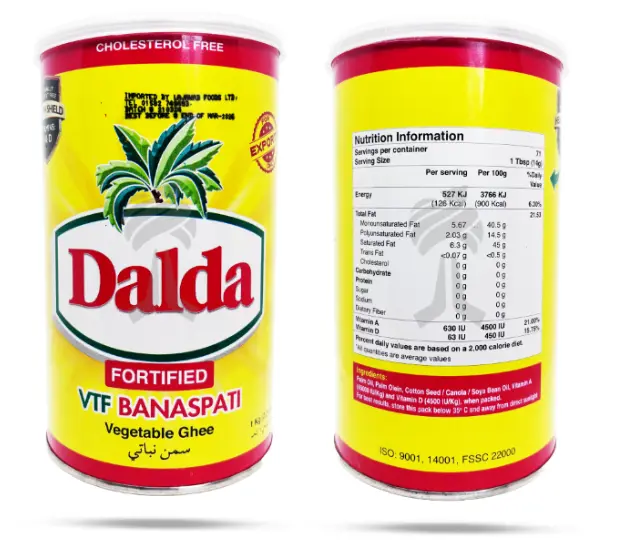
But let’s be honest – it’s not purely rational. For many second- and third-generation Brits of Indian, Pakistani, or Bangladeshi heritage, Dalda represents continuity. In an era of fusion food, plant-based trends, and Instagrammable avocado toast, pulling out the yellow tin feels like a quiet act of cultural defiance. It’s the ingredient that makes your mum’s recipe taste exactly like hers did back in the 1980s. It’s what turns a simple batch of sooji halwa into something that transports you straight back to childhood.
Of course, times have changed. Younger cooks might reach for coconut oil, olive oil blends, or artisanal ghee for everyday use. Health conversations around saturated fats and processing are real, and many households have shifted towards lighter options. Yet Dalda endures – not as the everyday default for everyone, but as the go-to for authenticity in certain dishes. It’s the secret behind that perfect flaky texture in parathas, the binding richness in mithai, the unmistakable depth in restaurant-style curries recreated at home.
So here we are in modern British kitchens: sleek induction hobs alongside tandoor ovens, quinoa next to quinoa pilau, and somewhere on the shelf, a tin of Dalda. It’s a bridge between then and now – between the subcontinent our grandparents left and the Britain we call home. Nostalgia in solid form, still quietly doing its job, one sizzling spoonful at a time.
What about you? Does your family still keep a tin of Dalda handy? Drop a comment below – I’d love to hear your stories.


